Some of the recent research topics that I was involved in are briefly summarized below. My contribution lies mainly in the development and use of computational methods to analyze experimental results, and, thereby, to extract useful information about the system under study. Currently, I'm researching on spin waves in nanostructures.
________________________________________________________________________
Collective Spin Waves in High-Density Two-Dimensional Arrays of FeCo Nanowires
Arrays of magnetic nanoelements, such as nanowires, have generated much interest lately because they show great promise as magnetic memory and sensor devices, as well as in spintronic and medical applications. For instance, high density arrays of vertically oriented nanowires made of high anisotropic magnetic materials are competitive candidates for future perpendicular magnetic media capable of storage densities exceeding 1 terabit/in. Much experimental research has been undertaken on the spin dynamics in isolated nanoelements, e.g., spin wave confinement effects arising from the low dimensionality of these nanoelements. In contrast, experimental data on collective magnetic excitations, arising from dipolar interactions, in arrays of nanoelements are relatively scarce. Dipolar interactions in dense arrays, particularly two-dimensional ones, are important because magnetic properties, like remanence and coercivity, can be quite different from those of noninteracting arrays. From a technological point of view, dipolar interactions can result in phenomena such as crosstalk between neighboring nanomagnets which can severely affect the performance of potential devices based on such arrays, particularly magnetic storage devices which rely on a high-density packing of nanomagnets. Hence an understanding of collective spin wave modes is of great importance technologically and also from a fundamental science point of view.
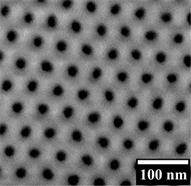
In the following, we present our Brillouin studies of the magnetic field dependence of collective spin waves in hexagonally ordered 2-D arrays of vertically oriented Fe48Co52 nanowires (right figure). The arrays have wires with fixed diameters of 20 nm and wire spacing radius ratios ranging from 3 to 5.5.
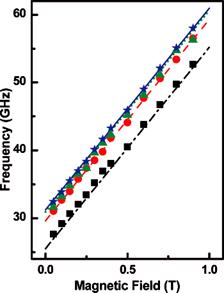
The left figure shows the magnetic field dependence of the frequencies of the lowest energy spin wave in the four Fe48Co52 nanowire arrays. Experimental data are denoted by symbols for the arrays with interwire separations s = 30 nm (square), 40 nm (circle), 50 nm (triangle), and 55 nm (star). The experimental errors are smaller than the symbols shown. Theoretical collective spin wave mode frequencies are represented by lines: s = 30 nm (dashed-dotted line), 40 nm (dashed line), 50 nm (dotted line), and 55 nm (solid line). Good agreement between theory and experiment is obtained.
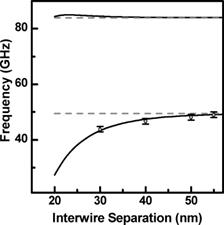
Frequencies of the spin waves in Fe48Co52 nanowire arrays as a function of interwire separation, at a longitudinal magnetic field of 0.6 T are shown above. In the figure, experimental data are denoted by dots with error bars. Calculated frequencies of the two lowest energy collective spin wave modes are represented by solid lines. Corresponding predicted frequencies for the isolated single nanowire are shown as horizontal dashed lines.
It is noted that the influence of neighbouring wires in the arrays is manifested as a depression of the frequency of the lowest lying energy collective spin wave mode relative to that of the isolated wire. Interestingly, the frequency depression increases with decreasing interwire separation. It is to be noted too that the measured frequency value of 49.0 GHz for this collective spin wave mode, for s = 55 nm, is close to the theoretical frequency of 49.5 GHz for the corresponding mode of the isolated wire. This suggests that the interwire dipolar coupling is negligible for s ³ 55 nm. In contrast, the higher-energy mode is virtually unaffected by the presence of neighboring wires.
Thus, the results provide clear conclusive evidence of collective magnetic excitations in 2-D ordered arrays of ferromagnetic nanowires. It follows that interwire dipolar coupling plays an important role in the fundamental nanoscience of high density 2-D arrays of nanomagnets. Additionally, increasing the density packing not only will raise magnetic storage capacity but also will increase undesirable crosstalk between nanomagnets. As this will limit the performance of potential devices based on magnetic nanowire arrays, the findings of this study are of great importance to the future technological development of such devices.
Reference:
Z. K. Wang, H. S. Lim, V. L. Zhang, J. L. Goh, S. C. Ng, M. H. Kuok et al., Nano Letters (2006).
________________________________________________________________________
Micro-Brillouin scattering from a single isolated nanosphere
Inelastic light scattering from a single isolated silica sphere, of diameter as small as 260 nm, has been successfully measured as a function of sphere size by micro-Brillouin spectroscopy. These measurements allow a rigorous verification of Lamb's theory for acoustic modes confined in a sphere with a free surface.
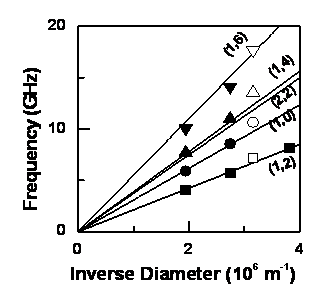
The figure on the left shows the dependence of frequency of confined acoustic modes in silica single spheres on inverse sphere diameter. Experimental data are denoted by full symbols for d = 262, 364 and 515 nm and by open symbols for d = 320 nm. The measurement errors are the size of the symbols displayed. The solid lines represent the theoretical frequencies of various acoustic modes labeled by (n, l). It is therefore established that the elastic properties of single nanospheres can be evaluated by this technique.
Brillouin spectra of synthetic silica opal crystals are also measured. An asymmetric broadening of the opal spectra, relative to corresponding component single-sphere ones, is observed. The figure below shows the measured and fitted Brillouin intensity profiles of the (1, 2) acoustic mode of (a) the d = 320 nm opal, and (b) the d = 262 nm opal. The insets show the spectral profiles, for corresponding single silica spheres, fitted with a Lorentzian function.


Experimental data are denoted by dots. The solid lines, in the opal case, represent the best fit of experimental data with the following equation

where sigma is the standard deviation of the size distribution and

is
the convolution of a natural line profile of a singe sphere with the
instrumental resolution function  As can be
seen, the observed asymmetric broadening in the opal sample can be well
accounted for by particle size distribution, suggesting that the damping arising
from the coupling between adjacent nanospheres in the opals is a relatively
insignificant contributing factor to the linewidth broadening.
This asymmetric broadening affords a new method for determining the size polydispersity of the opal nanospheres.
As can be
seen, the observed asymmetric broadening in the opal sample can be well
accounted for by particle size distribution, suggesting that the damping arising
from the coupling between adjacent nanospheres in the opals is a relatively
insignificant contributing factor to the linewidth broadening.
This asymmetric broadening affords a new method for determining the size polydispersity of the opal nanospheres.
Reference:
Y Li, H. S. Lim, S. C. Ng, Z. K. Wang, M. H. Kuok et al., Applied Physics Letters 88, 023112 (2006).
________________________________________________________________________
Spin Waves in Magnetic Nanoring
Magnetic nanorings are excellent candidates for high-density storage devices because of the existence of vortex or flux-closed states in which the magnetization is oriented circularly and for which stray magnetic fields are essentially absent. Previous studies using 2-D micromagnetic simulation show that an ‘onion’ state exists in the flat micro-sized rings when the transversely applied magnetic decreases from saturation.
Recently, we have reported on an inelastic light scattering (Brillouin) study of
spin excitations in magnetic nanorings. The
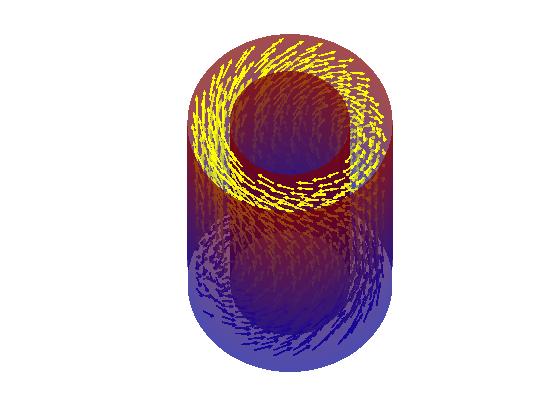 magnetization
distributions within the high-aspect-ratio nanorings were theoretically
determined at various longitudinally applied magnetic fields. The simulations
show that under strong fields the spins are aligned along the field direction
(i.e., parallel to the symmetry axis of the rings) corresponding to what we call
the ‘bamboo’ state. Below a certain critical field, the rings switch to another
state which we call ‘twisted bamboo’ state. An interesting feature of this state
is the opposite circulation of the component of spins in the top and bottom
planes normal to ring axis, while in the middle planes the spins are essentially
parallel to the ring axis.
magnetization
distributions within the high-aspect-ratio nanorings were theoretically
determined at various longitudinally applied magnetic fields. The simulations
show that under strong fields the spins are aligned along the field direction
(i.e., parallel to the symmetry axis of the rings) corresponding to what we call
the ‘bamboo’ state. Below a certain critical field, the rings switch to another
state which we call ‘twisted bamboo’ state. An interesting feature of this state
is the opposite circulation of the component of spins in the top and bottom
planes normal to ring axis, while in the middle planes the spins are essentially
parallel to the ring axis.
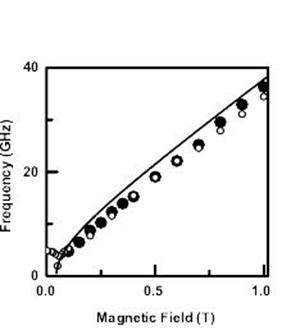
On the right, we have the magnetic field dependence of the frequencies of spin waves in a nickel nanoring. Measured frequencies are represented by closed circles, while calculated ones (micromagnetic simulations) by open circles. The solid curve is the result of an analytical expression. Good agreement is found between the measured and calculated magnetic field dependence of the nanoring spin wave frequency. The results of this study show that it will be critically important to take account of these end effects in future developments of quantum nanomagnet technology.
Reference:
Z. K. Wang, H. S. Lim, H. Y. Liu, S. C. Ng, M. H. Kuok et al., Physical Review Letters 94, 137208-1 (2005).
________________________________________________________________________
Quantization of acoustic modes in nanospheres
Due to its low dimension and high surface-to-volume ratio, nanoparticles are expected to exhibit anomalous thermal, mechanical, electrical and magnetic properties as a consequence of confinement effects. Due to these effects, distinct physical properties appear. The frequency spectrum of phonons, for instance, is restricted to a discrete set in a small confined space and can significantly affect the optical properties of semiconductor microcrystals.
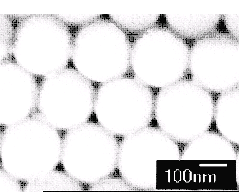
In this project, my collaborator (Prof Kuok M H) has provided a first clear experimental evidence of the quantization of acoustic modes in a nanoparticle arising from spatial confinement. The measurement was made in matrix-free arrays of monodisperse SiO2 nanospheres (left picture) by Brillouin light scattering.
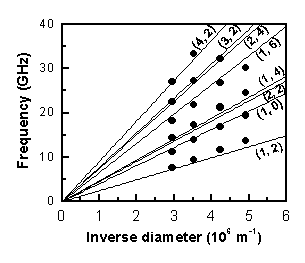
To analyze the measured peak frequencies, we use the Lamb’s theory and found that the peak frequencies vary inversely proportional to the diameter of the nanospheres, in agreement with experiment. (In the Figure on the right, experimental data are denoted by solid circles while the lines represent the theoretical frequencies*.) The distinct spectral peaks also afford an unambiguous assignment of six surface and inner spheroidal acoustic modes, the largest number of modes observed so far. This study also yielded information on the elastic properties of amorphous SiO2 nanospheres. In particular, the Young’s modulus was found to be significantly lower than that of bulk silica.
This work has also been featured in Physical Review Focus and also appears in the Virtual Journal of Nanoscale Science & Technology--July 7, 2003, Volume 8, Issue 1.
Reference:
M. H. Kuok, H. S. Lim, S. C. Ng, N. N. Liu, Z. K. Wang, Physical Review Letters 90, 255502 (2003).
H. S. Lim, M. H. Kuok, S. C. Ng and Z. WANG, Applied Physics Letters 84, 4182 (2004).
________________________________________________________________________
Size distribution of Si nanoparticles in natural and electrochemical
oxidized porous silicon films
In
order to verify that the oxidation in porous Si film leads to a reduction in the
size of the Si nanoparticle, Raman scattering was performed on both naturally
oxidized and electrochemically oxidized samples.
Each spectrum comprises
of a broad asymmetric tail at a frequency range slightly below 520 cm-1,
characteristic of Si nanostructures. The average size,
 ,
of the Si nanocrystal and its spread (variance) can be estimated from the Raman
spectrum within a phonon confinement model, and also assuming that the crystallite size distribution function is given by a
Gaussian distribution with a standard deviation σ.
,
of the Si nanocrystal and its spread (variance) can be estimated from the Raman
spectrum within a phonon confinement model, and also assuming that the crystallite size distribution function is given by a
Gaussian distribution with a standard deviation σ.
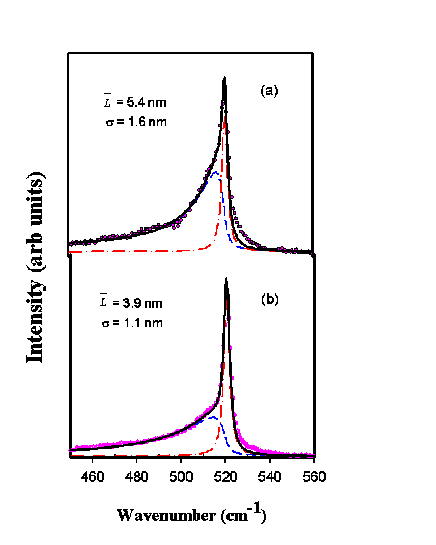
The Figure gives a comparison between experimental (denoted by pink circles) and theoretical (black lines) Raman spectra for (a) a porous Si sample naturally oxidized for one day, and (b) a porous Si sample electrochemically oxidized for 5 min. The experimental data were obtained from Prof. Kuok's Brillouin group.
The theoretical spectral component
due to phonon confinement is represented by blue line while the crystalline Si
peak at 520.5 cm-1 is given by the red line. Excellent agreement
between experiment and theory is achieved,
from which the average size
and the standard
deviation σ of the nano-crystallites in the porous Si film can be obtained.
Similar analyses performed on many other oxidized samples have clearly revealed that both oxidation methods have reduced the size of silicon nanoparticles. The results are rather consistent, even though they are effected at very different rates.
Reference:
H. J. Fan, M. H. Kuok, S. C. Ng, H. S. Lim, and N. N. Liu, Journal of Applied Physics 94, 1243 (2003).
________________________________________________________________________
Evaluation of acoustic physical
constants of LiNbO3 at hypersonic frequencies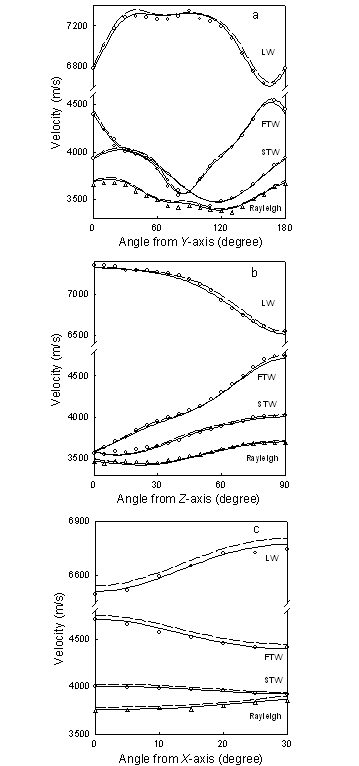
As a crystal belonging to a class of 3m of the
trigonal system, LiNbO3 has 12 acoustical physical constants
comprising six elastic constants at constant electric field
( ,
,
 ,
,
 ,
,
 ,
,
 and
and
 ),
four piezoelectric stress
constants (
),
four piezoelectric stress
constants ( ,
,
 ,
,
 and
and
 ), and two dielectric
constants at constant strain (
), and two dielectric
constants at constant strain ( and
and  ).
).
The constants at hypersonic frequencies can be determined by fitting the experimental bulk velocities, and/or generalized Rayleigh surface waves, to theoretical calculations.
The Figure gives the angular dispersion of Rayleigh and bulk acoustic waves in (a) X-cut, (b) Y-cut and (c) Z-cut LiNbO3. Data from the Brillouin scattering experiments of Prof. Kuok's group are denoted by open triangles for the Rayleigh wave while those for the STW (slow transverse wave), FTW (fast transverse wave) and LW (longitudinal wave) are signified by circles. Also shown are the theoretical branches based on our fitted constants (solid curves) and those of Kushibiki et al (dashed curves). The latter obtained their fitted constants via ultrasonic means.
The comparison shows that our fitted constants are more accurate at hypersonic frequencies. The development of surface acoustic wave (SAW) devices for GHz-band signal filters, for example, often requires such devices to operate in the gigahertz range for optimum operation. Thus, the study of high-frequency properties of SAW substrates is important. In this regard, our fitted constants are more appropriate or reliable for SAW device design calculations.
Reference:
H. S. Lim, J. D. Huang, V. L. Zhang, M. H. Kuok, and S. C. Ng, Journal of Applied Physics 93, 9703 (2003).
________________________________________________________________________