NUS.Physics Society
Physoc.Lab Tours
Do you know that there are quite a lot of cool Physics labs all over the Physics Department? Physoc organizes lab tours to bring students around and check out these labs. There are lots of things to see and learn in these labs! Who knows, they might even be your future working place.
Event Summary for Lab Tour in Physics Department (2009)
The lab tour was organized with the aim to let the physics majors to know more about the research activities that are currently present in the Physics department. In addition, the common research facilities in the department were also introduced to them. This tour is targeted to the 1st and 2nd year physics majors.
It was held on 9th Jan 2009, from 9am to 4pm. The whole event started with a tour at the Singapore Synchrotron Light Source (SSLS) which is situated behind the School of Business, with Dr Gao Xingyu bringing the students touring around the whole building. He explained the background of a synchrotron light source, how was it being constructed and how did the researchers utilize the beams that are being emitted from high speed charges. Then he brought them to look at the individual beam lines that were constructed and explained their usage. In SSLS, researchers are able to do lithography (patterning), characterize materials by performing X-ray Diffraction (XRD), X-ray Photoelectron Spectroscopy (XPS), X-ray Fluorescence (XRF), and Fourier Transform Infrared Spectroscopy (FTIR), as well as phase contrast imaging.
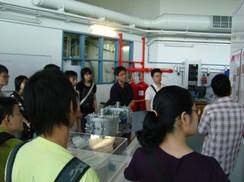
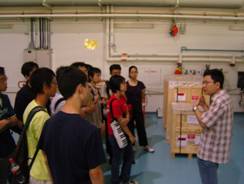
The tour in SSLS lasted for around 45 minutes, and the students went back to the physics department for the next tour. The students went to the Surface Science Lab (SSL), where the XPS and Scanning Tunneling Microscope (STM) were situated. The lab officer Mr Wong and 2 graduate students explained the principles behind XPS and STM to the students and showed them what both XPS and STM can analyze. They also showed the students how XPS perform its measurements.
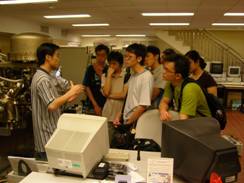
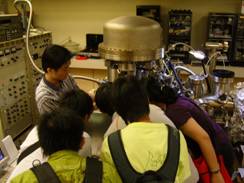
Next, the students went to the Colloid and nanomaterials lab, and they were guided by Sharon, who is a research assistant of the lab. She described the research areas that the lab embarked on, which are carbon nanotubes (CNTs), metal oxide nanostructures and optical tweezers. Then they got the opportunity to create patterns using focused laser beam on CNT.
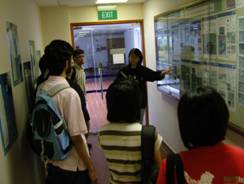
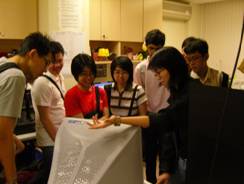
Before heading for their lunch, they went to visit the common research facilities in the department, mainly Scanning Electron Miscroscope (SEM), X-ray Diffractometer (XRD) and Atomic Force Microscope (AFM). Minrui, a graduate student, explained the principles and the usage of SEM to the students, and also demonstrated how the SEM can do imaging of small and tiny samples. Yilin, who is also a graduate student, explained how AFM and XRD work, and how they perform measurements and analysis on the measurements.
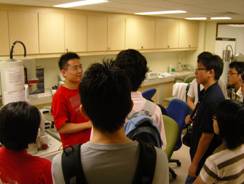
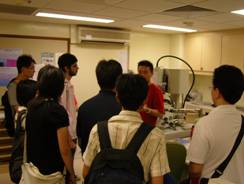
After their lunch, the students went to the Centre of Superconducting and Magnetic Materials (CSMM) lab. Siew Leng, a PhD student of the lab, showed them the Pulsed Laser Deposition (PLD) machine, which is used to deposit a thin film on a substrate by using pulsed UV laser. She also showed them the RF sputtering machine, which is another technique to create thin film. She then concluded the tour by showing the systems that perform microwave measurements.
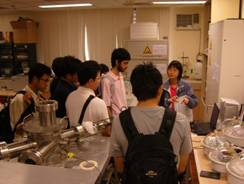
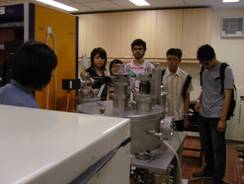
After that, the students went to the Biophysics Lab, with Dr Du Ning guiding them into the research labs. She explained the types of instruments that are used in the research labs to the students, like the advanced surface tensiometer system is used to measure the surface tension between the interfaces. She also brought them to the biophysics teaching labs, showing the circular dichroism measurement system, as well as the fluorescence spectrometer and UV-Vis spectrometer which are used in the characterization of biomolecules.
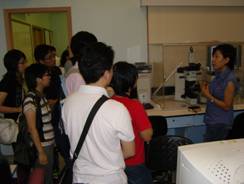
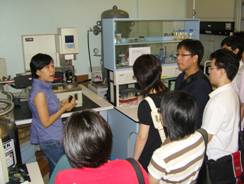
The students went for Centre for Ion Beam Applications (CIBA) lab, which is just beside the biophysics teaching labs. Mr Chiam, a research assistant of the lab, provided description of the particle accelerator system that is situated inside. He also mentioned about the usage of the high energy alpha particles in lithography, biomedical imaging and materials characterization. He also brought them to an imaging lab to show them the facilities and the research on photonics materials.
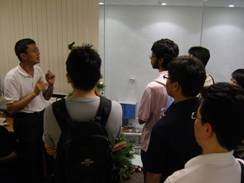
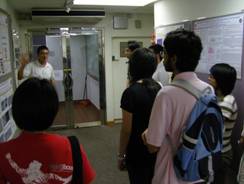
The last place they toured was the Centre of Quantum Technologies (CQT). Prof Scarani provided them a brief overview on what kind of research that is taking place in CQT. Then they were brought to the applied quantum lab, which was guided by graduate students and research assistants. The experiments were mainly consisting of mirrors, lasers and light detectors, however with complicated setups and arrangements. In another lab, Dr Murray described his cold atom experiments to the students and they roughly knew what the researchers did in the lab.
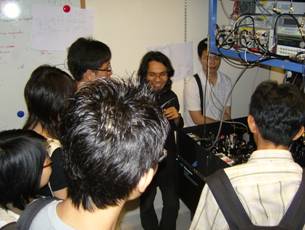
At the end of the day, the students were brought to the Physics Conference Room for departmental tea. They complained about the weariness of the tour due to long hours of standing throughout the whole tour. However, they found that the tour was beneficial on the whole and they were amazed by the research activities in the department. Some of the them suggested that the tour to be held in 2 consecutive days or held at a shorter time, so that they will not feel tired after the tour.
The Physics Society would like to take this opportunity to thank the following people for making this lab tour successful:
- Miss Sng Wee Lee,
- Dr Gao Xingyu from SSLS,
- Mr Wong and graduate students from SSL,
- Sharon, Yilin and Minrui from Colloid lab,
- Dr Du Ning and Dr Zhang Keqin from Biophysics lab,
- Siew Leng from CSMM,
- Sher Yi from CIBA,
- Prof Scarani,
- Dr Murray and graduate students from CQT,
- and lastly the respective heads of research labs,
for informing the research labs, bringing the students around in the respective research labs, and for granting us permission for touring the labs.