Set 4
\[ \newcommand\v[1]{\boldsymbol{#1}} \newcommand\vdot[2]{\v{#1}\cdot\v{#2}} \]
\[ \newcommand{\dd}[2][]{\mathrm{d}^{#1}#2} \]
\[ \newcommand\f[2]{\dfrac{#1}{#2}} \newcommand\da[2]{\dfrac{d #1}{d #2}} \newcommand\daa[2]{\dfrac{d^2 #1}{d #2^2}} \newcommand\pa[2]{\dfrac{\partial #1}{\partial #2}} \newcommand\pal[3]{\left.\dfrac{\partial #1}{\partial #2}\right|_{#3}} \newcommand\paa[2]{\dfrac{\partial^2 #1}{\partial #2^2}} \newcommand\pab[3]{\dfrac{\partial^2 #1}{\partial #2 \partial #3}} \def\half{\frac{1}{2}} \]
\[ \newcommand\ket[1]{\left|#1\right\rangle} % |x> \newcommand\exp[1]{\left\langle#1\right\rangle} % <x> \newcommand\lr[1]{\left(#1\right)} % (x) \newcommand\lrs[1]{\left[#1\right]} % [x] \newcommand\lra[1]{\left|#1\right|} % |x| \newcommand\lrc[1]{\left\{#1\right\}} % {x} \newcommand\lrl[3]{\left.#1\right|_{#2}^{#3}} % x_limits \]
\[ \def\ie{\text{i.e.}\quad} \]
\[ \newcommand{\me}[3][\rightarrow]{{#2}#1{#3}} % Typical reaction \newcommand{\nr}[3]{{#1}\,({#2})\,{#3}} % Nuclear reactions \newcommand{\ele}[4]{_{#2}^{#3}{\textbf{#1}}_{#4}} \newcommand{\el}[2]{^{#2}\text{#1}} \newcommand{\til}[2][\mathbf{\sim}]{\underset{#1}{{#2}}} \newcommand{\b}[1]{\overline{#1}} \]
\[ \newcommand{\coulomb}[1]{\dfrac{#1}{4\pi\epsilon_0}} \def\degree{^*} \]
\[ \def\amu{\text{ amu}} \def\J{\text{ J}} \def\K{\text{ K}} \def\s{\text{ s}} \def\second{\text{ s}} \def\Psecond{\text{ s}^{-1}} \def\m{\text{ m}} \def\mm{\text{ mm}} \def\km{\text{ km}} \def\fm{\text{ fm}} \def\mum{\text{ $\mu$m}} \def\mus{\text{ $\mu$s}} \def\mPERs{\text{ ms$^{-1}$}} \def\eV{\text{ eV}} \def\keV{\text{ keV}} \def\GeV{\text{ GeV}} \def\MeV{\text{ MeV}} \def\MeVc{\text{ MeV/c$^2$}} \def\KeVc{\text{ KeV/c$^2$}} \newcommand\ttp[1]{\times 10^{#1}} % To The Power \]
\[ \def\en{\nu_e} \def\Aen{\b{\nu_e}} \def\mun{\nu_\mu} \def\Amun{\b{\nu}_\mu} \]
\[ \def\uraniumA{\ele{U}{92}{233}{}} \def\uraniumB{\ele{U}{92}{235}{}} \def\uraniumC{\ele{U}{92}{238}{}} \def\carbonB{\ele{C}{6}{14}{}} \def\nitrogenB{\ele{N}{7}{14}{}} \def\oxygenA{\ele{O}{8}{14}{}} \def\oxygenB{\ele{O}{8}{16}{}} \]
\[ % \def\com{\text{\scriptsize CM}} \def\com{\mathrm{\scriptsize CM}} \]
\[ \def\l{l} \]
\[ \def\g{\gamma} \]
Problems
Problem 4.1(Parity of the Spherical Harmonics)
Consider a particle in a state with definite orbital angular momentum, whose spatial wavefunction is
\[ \psi_{n\ell m}(r,\theta,\phi) = R_{n\ell}(r)Y_\ell^m(\theta,\phi). \]
Under a parity transformation,
\[ \mathbf r\rightarrow-\mathbf r, \]
the spherical coordinates transform as
\[ (r,\theta,\phi) \rightarrow (r,\pi-\theta,\phi+\pi). \]
Starting from the general expression for the spherical harmonics given in Equation 3.1, show that
\[ Y_\ell^m(\pi-\theta,\phi+\pi) = (-1)^\ell Y_\ell^m(\theta,\phi). \]
Hence, show that the orbital parity of a particle state with orbital angular momentum quantum number \(\ell\) is
\[ \eta=(-1)^\ell. \]
State the orbital parity of the states with \(\ell=0,1,2,\) and \(3\).
Problem 4.2(Energy Transfer in the CM Frame)
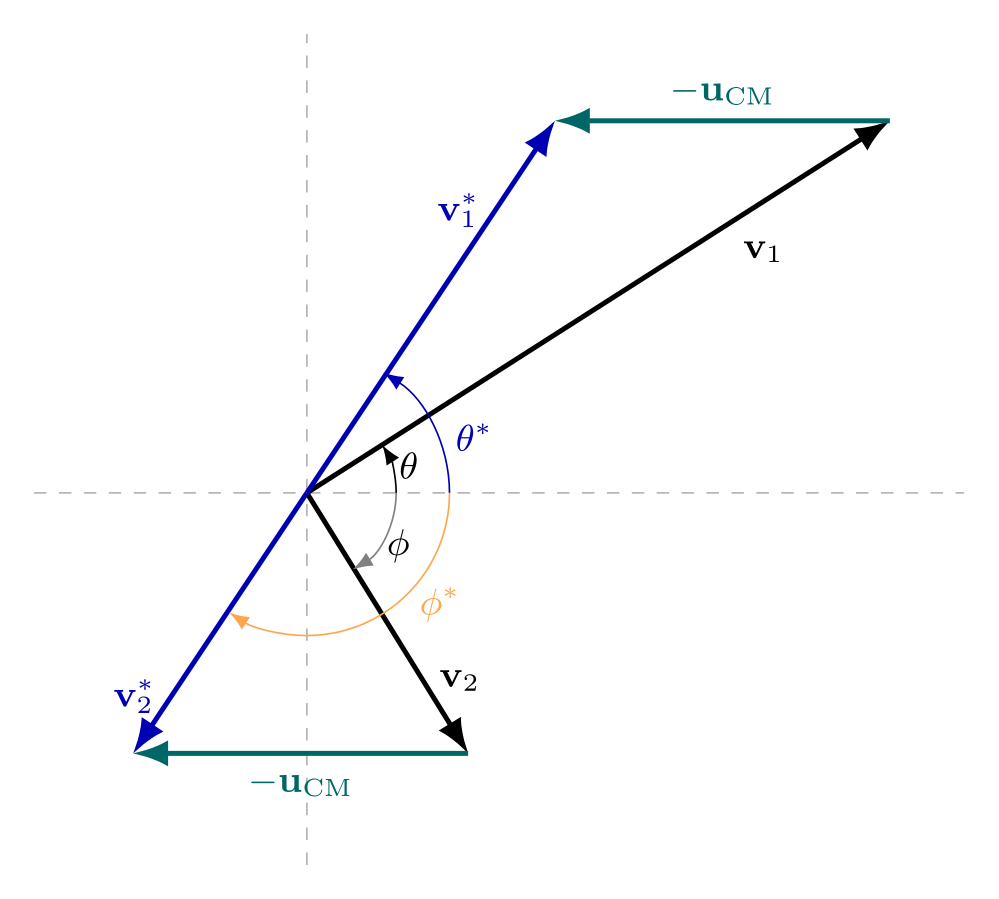
A projectile of mass \(m_1\) and initial kinetic energy \(E_0\) undergoes a non-relativistic elastic collision with a stationary target of mass \(m_2\). The figure shows the velocities in the CM and LAB frames after the collision. Here, \(\theta^*\) is the scattering angle of the projectile in the CM frame. Refer to Chapter 8 Centre of Mass Frame* for further details.
Show that the kinetic energy \(T\) transferred to the target is
\[ T = E_0 \frac{4m_1m_2}{(m_1+m_2)^2} \sin^2\frac{\theta^*}{2}. \tag{1.1}\]
Determine the maximum energy that can be transferred to the target.
At what value of \(\theta^*\) does this occur?
Under what condition on \(m_1\) and \(m_2\) can the projectile transfer all its kinetic energy to the target?
Let \(E_1\) be the kinetic energy of the projectile after the collision. Show that
\[ \frac{E_1}{E_0} = \frac{A^2+1+2A\cos\theta^*}{(A+1)^2}, \tag{1.2}\]
where
\[ A=\frac{m_2}{m_1}. \]
Determine the minimum and maximum possible values of \(E_1/E_0\). State the value of \(\theta^*\) corresponding to each limit and explain the physical meaning of the two cases.
Problem 4.3(Energy Transferred to a Target)
A beam of \(100\keV\) \(^{11}\mathrm{B}\) ions is incident on a thin silicon target. A detector records elastically scattered boron ions at a LAB-frame angle of \(\theta=45^\degree\).
- Determine the corresponding scattering angle \(\theta^*\) in the CM frame.
- Hence, determine the kinetic energy transferred to the silicon nucleus in each detected collision.
- What is the kinetic energy of the scattered boron ion?
Assume that the silicon atoms are initially at rest, neglect energy loss within the target, and take the target nuclei to be \(^{28}\mathrm{Si}\).
Problem 4.4(Choosing a Neutron Moderator)
In an elastic collision between a neutron and a stationary nucleus of mass \(A m_n\), the minimum possible fraction of the neutron’s initial kinetic energy that remains after one collision is
\[ \left(\frac{E_1}{E_0}\right)_{\min} = \left(\frac{A-1}{A+1}\right)^2. \]
A reactor designer is considering hydrogen, carbon, and lead as neutron moderators. Take their approximate mass numbers to be
\[ A_{\mathrm{H}}=1, \qquad A_{\mathrm{C}}=12, \qquad A_{\mathrm{Pb}}=207. \]
- For each material, calculate the maximum fraction of the neutron’s energy that can be lost in a single elastic collision.
- Rank the three materials according to their effectiveness at slowing neutrons through elastic collisions.
- Explain physically why matching the target mass to the neutron mass maximises the energy transfer.
- A neutron will not undergo a perfectly head-on collision every time. Explain why the result for the maximum energy transfer is therefore not, by itself, sufficient to determine how many collisions are needed to slow a neutron.
- Hydrogen is excellent at slowing neutrons, but a useful moderator must have other suitable properties. Identify two additional factors that should be considered when choosing a practical moderator.
- Explain why a material that is effective at slowing neutrons is not necessarily effective at absorbing them.
Problem 4.5(Angular Compression in the LAB Frame)
Consider elastic scattering from a stationary target. For each of the following cases, use
\[ \tan\theta = \frac{\sin\theta^*}{\cos\theta^*+m_1/m_2} \]
to investigate how CM angles appear in the LAB frame:
- a neutron scattering from a lead nucleus;
- an alpha particle scattering from a proton; and
- a proton scattering from another proton.
For each case:
- determine whether the projectile can be scattered backwards in the LAB frame;
- describe whether a wide range of CM angles is compressed into a small range of LAB angles; and
- explain the result using the motion of the CM.
- Finally, state whether the observation of predominantly forward LAB scattering necessarily means that the interaction itself is strongly forward-peaked in the CM frame.
Problem 4.6(Neutron–Proton Scattering)
A neutron undergoes an elastic collision with a stationary proton.
Taking \(m_n\approx m_p\), show that the LAB and CM scattering angles of the neutron are related by \[ \theta=\frac{\theta^*}{2}. \]
What is the largest possible LAB scattering angle of the neutron?
A neutron is scattered through \(60^\circ\) in the CM frame. At what angle is it observed in the LAB frame?
Explain physically why the incident neutron cannot be scattered backwards in the LAB frame when the target has approximately the same mass.
At what CM scattering angle does the neutron transfer all its kinetic energy to the proton?