Set 9
\[ \newcommand\v[1]{\boldsymbol{#1}} \newcommand\vdot[2]{\v{#1}\cdot\v{#2}} \]
\[ \newcommand{\dd}[2][]{\mathrm{d}^{#1}#2} \]
\[ \newcommand\f[2]{\dfrac{#1}{#2}} \newcommand\da[2]{\dfrac{d #1}{d #2}} \newcommand\daa[2]{\dfrac{d^2 #1}{d #2^2}} \newcommand\pa[2]{\dfrac{\partial #1}{\partial #2}} \newcommand\pal[3]{\left.\dfrac{\partial #1}{\partial #2}\right|_{#3}} \newcommand\paa[2]{\dfrac{\partial^2 #1}{\partial #2^2}} \newcommand\pab[3]{\dfrac{\partial^2 #1}{\partial #2 \partial #3}} \def\half{\frac{1}{2}} \]
\[ \newcommand\ket[1]{\left|#1\right\rangle} % |x> \newcommand\exp[1]{\left\langle#1\right\rangle} % <x> \newcommand\lr[1]{\left(#1\right)} % (x) \newcommand\lrs[1]{\left[#1\right]} % [x] \newcommand\lra[1]{\left|#1\right|} % |x| \newcommand\lrc[1]{\left\{#1\right\}} % {x} \newcommand\lrl[3]{\left.#1\right|_{#2}^{#3}} % x_limits \]
\[ \def\ie{\text{i.e.}\quad} \]
\[ \newcommand{\me}[3][\rightarrow]{{#2}#1{#3}} % Typical reaction \newcommand{\nr}[3]{{#1}\,({#2})\,{#3}} % Nuclear reactions \newcommand{\ele}[4]{_{#2}^{#3}{\textbf{#1}}_{#4}} \newcommand{\el}[2]{^{#2}\text{#1}} \newcommand{\til}[2][\mathbf{\sim}]{\underset{#1}{{#2}}} \newcommand{\b}[1]{\overline{#1}} \]
\[ \newcommand{\coulomb}[1]{\dfrac{#1}{4\pi\epsilon_0}} \def\degree{^*} \]
\[ \def\amu{\text{ amu}} \def\J{\text{ J}} \def\K{\text{ K}} \def\s{\text{ s}} \def\second{\text{ s}} \def\Psecond{\text{ s}^{-1}} \def\m{\text{ m}} \def\mm{\text{ mm}} \def\km{\text{ km}} \def\fm{\text{ fm}} \def\mum{\text{ $\mu$m}} \def\mus{\text{ $\mu$s}} \def\mPERs{\text{ ms$^{-1}$}} \def\eV{\text{ eV}} \def\keV{\text{ keV}} \def\GeV{\text{ GeV}} \def\MeV{\text{ MeV}} \def\MeVc{\text{ MeV/c$^2$}} \def\KeVc{\text{ KeV/c$^2$}} \newcommand\ttp[1]{\times 10^{#1}} % To The Power \]
\[ \def\en{\nu_e} \def\Aen{\b{\nu_e}} \def\mun{\nu_\mu} \def\Amun{\b{\nu}_\mu} \]
\[ \def\uraniumA{\ele{U}{92}{233}{}} \def\uraniumB{\ele{U}{92}{235}{}} \def\uraniumC{\ele{U}{92}{238}{}} \def\carbonB{\ele{C}{6}{14}{}} \def\nitrogenB{\ele{N}{7}{14}{}} \def\oxygenA{\ele{O}{8}{14}{}} \def\oxygenB{\ele{O}{8}{16}{}} \]
\[ % \def\com{\text{\scriptsize CM}} \def\com{\mathrm{\scriptsize CM}} \]
\[ \def\l{l} \]
\[ \def\g{\gamma} \]
Problems
Problem 9.1(Nuclear Reactions (\(^{7}\)Li\((p,n)\)\(^{7}\)Be))
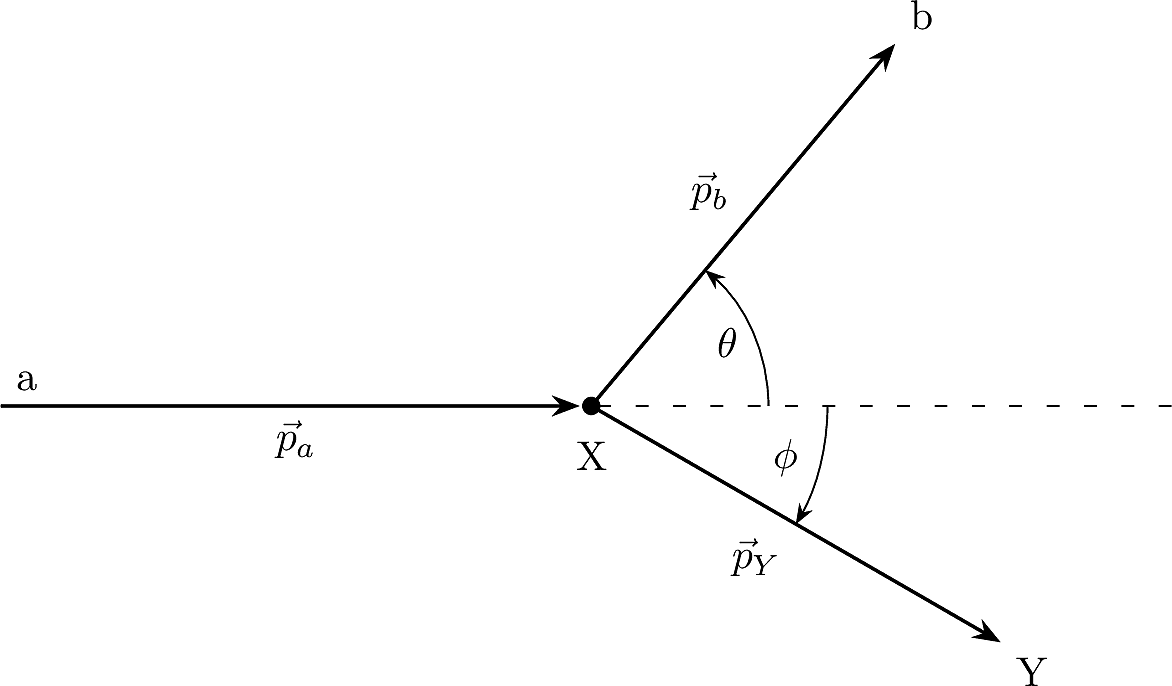
The figure shows the reaction geometry for the nuclear reactions \(X(a,b)Y\) whose \(Q\)-value is \(Q\).
Assuming non-relativistic energies, show that:
\[ Q = T_b\left(1+\frac{m_b}{m_Y}\right) - T_a\left(1-\frac{m_a}{m_Y}\right) - 2\left(\frac{m_a}{m_Y}\frac{m_b}{m_Y}T_aT_b\right)^{1/2}\cos\theta \]
and
\[ T_b^{1/2} = \frac{ \left( m_{a}m_{b}T_{a}\right)^{1/2}\cos \theta \pm \left\{ m_{a}m_{b}T_{a}\cos ^{2}\theta +\left( m_{Y}+m_{b}\right) \left[m_{Y}Q+\left( m_{Y}-m_{a}\right) T_{a}\right] \right\}^{1/2} }{ m_Y+m_b }. \]
Please note:
- \(m_i\) and \(T_i\) are the mass and kinetic energy of the particle labelled \(i\).
- Assume that \(X\) is initially at rest and that \(b\) is the lighter product (\(m_b < m_Y\)) that escapes the sample.
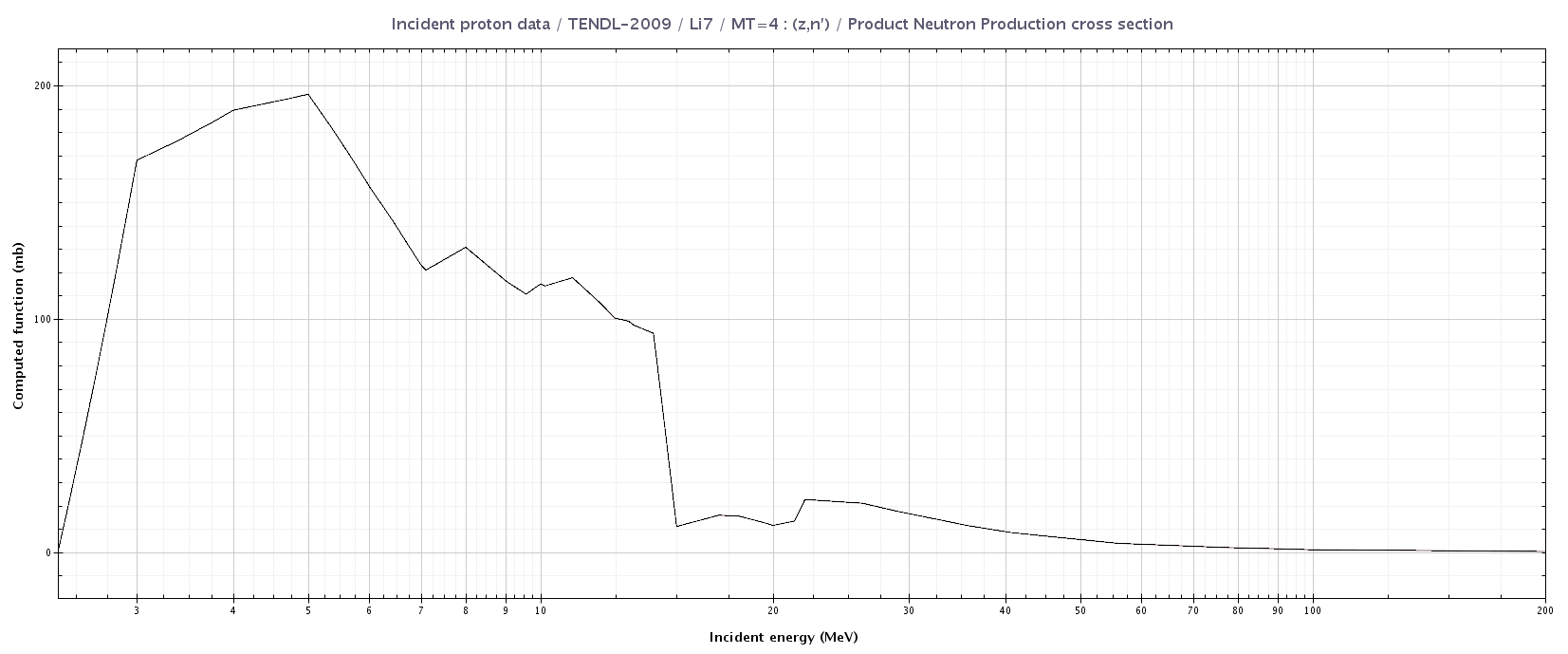
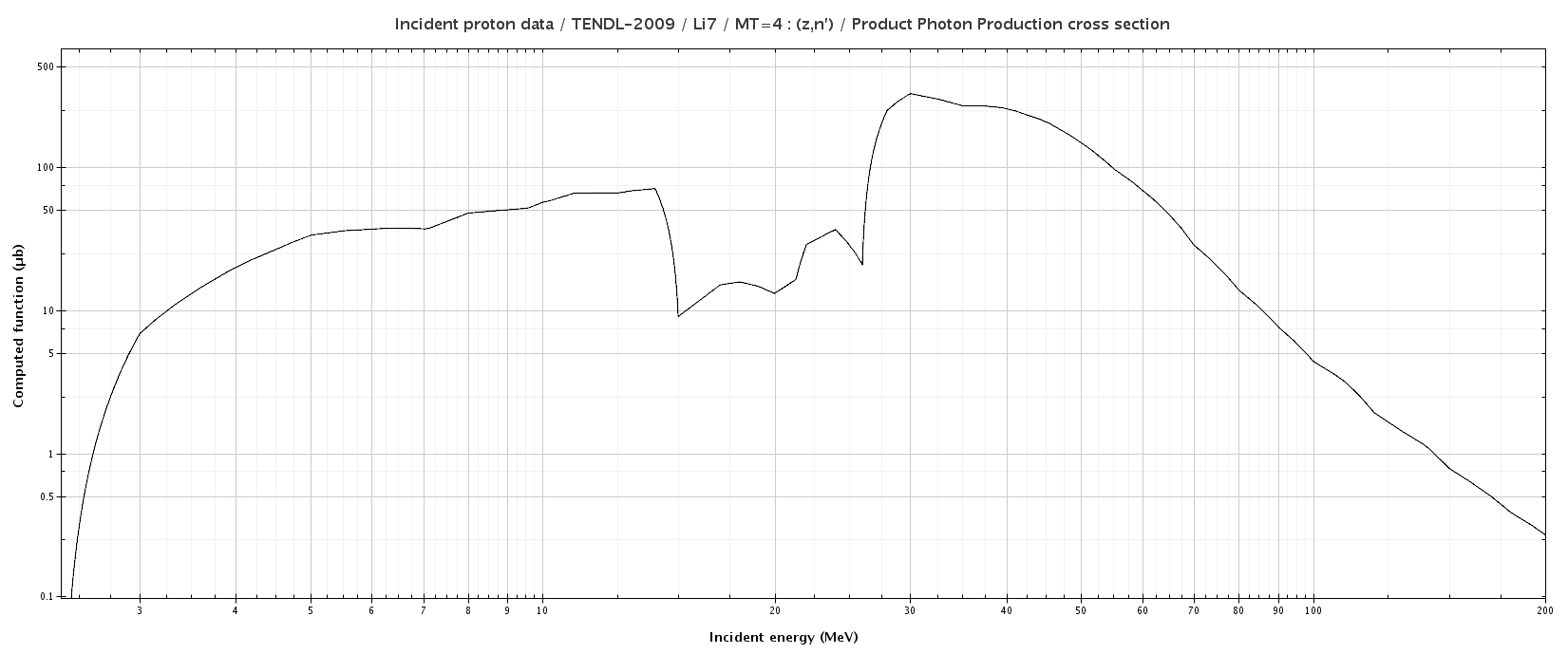
A neutron beam of 1.75 MeV is needed for a particular experiment. You are going to use a beam of protons to produce these neutrons via the reaction \(^{7}\)Li\((p,n)\)\(^{7}\)Be.
- Based on the data provided on below, what proton energy is best to produce the neutrons? Explain your choice.
In what direction relative to the incident beam will you find the 1.75 MeV neutrons?
If we extract the neutrons through a 1 cm aperture located 10 cm from the reaction target, what will be the energy spread (i.e. the energy resolution) of the neutron beam?
Are there other factors that will degrade the energy resolution of the beam of neutrons?
Problem 9.2(Protons from Fluorine)
15 MeV neutrons are projected at atoms of \(\ele{F}{}{}{}\) to produce protons using the reaction: \[ \me{\ele{F}{9}{19}{}+\ele{n}{0}{1}{}}{\ele{O}{8}{19}{}+\ele{H}{1}{1}{}} \]
The protons leave at an angle \(90\degree\) to the direction of the incident neutrons.
Calculate:
- the \(Q\) value of the reaction.
- the kinetic energy of the protons and
- the threshold energy for the reaction to take place.
You will need to refer to an online database for various values.
Problem 9.3(Q-value Calculation of a Decay)
Calculate the \(Q\)-value for the decay \(^{14}\text{C} \rightarrow {}^{14}\text{N} + \beta^- + \bar{\nu}_e\).
Compare this with the experimental value.
Problem 9.4(Nuclear Radius Approximation)
The radius of a nucleus may be approximated as \(R = r_0 A^{1/3}\). From the binding energy differences between odd-A mirror nuclei (i.e., a pair of nuclei having the same \(A\) but with neutron and proton numbers interchanged) in the mass range \(A = 11\) to \(17\), estimate the value of \(r_0\) assuming a uniform spherical charge distribution for each nucleus and ignoring effects other than Coulomb.
Problem 9.5(\(Q\) of Decays)
- Show that the \(Q\) value associated with \(\beta^\pm\) and Electron Capture (EC) can be expressed using nuclear masses (\(m\)) as:
\[ \def\betaMinus{Q_{\beta^+} = \lrs{m(Z, A) - m(Z+1, A) - m_e} c^2} \def\betaPlus{Q_{\beta^-} = \lrs{m(Z, A) - m(Z-1, A) - m_e} c^2} \def\ec{Q_{EC} = \lrs{m(Z, A) + m_e - m(Z-1, A)} c^2} \]
| Decay | \(Q\) |
|---|---|
| \(\beta^-\) | \(\betaMinus\) |
| \(\beta^+\) | \(\betaPlus\) |
| Electron Capture | \(\ec\) |
- Show that the \(Q\) value associated with \(\beta^\pm\) and Electron Capture (EC) can be expressed using atomic masses (\(M\)) as:
\[ \def\betaMinus{Q_{\beta^+} = \lrs{M(Z, A) - M(Z+1, A)} c^2} \def\betaPlus{Q_{\beta^-} = \lrs{M(Z, A) - M(Z-1, A) - 2m_e} c^2} \def\ec{Q_{EC} = \lrs{M(Z, A) - M(Z-1, A)} c^2} \]
| Decay | \(Q\) |
|---|---|
| \(\beta^-\) | \(\betaMinus\) |
| \(\beta^+\) | \(\betaPlus\) |
| Electron Capture | \(\ec\) |