Set 5
\[ \newcommand\v[1]{\boldsymbol{#1}} \newcommand\vdot[2]{\v{#1}\cdot\v{#2}} \]
\[ \newcommand{\dd}[2][]{\mathrm{d}^{#1}#2} \]
\[ \newcommand\f[2]{\dfrac{#1}{#2}} \newcommand\da[2]{\dfrac{d #1}{d #2}} \newcommand\daa[2]{\dfrac{d^2 #1}{d #2^2}} \newcommand\pa[2]{\dfrac{\partial #1}{\partial #2}} \newcommand\pal[3]{\left.\dfrac{\partial #1}{\partial #2}\right|_{#3}} \newcommand\paa[2]{\dfrac{\partial^2 #1}{\partial #2^2}} \newcommand\pab[3]{\dfrac{\partial^2 #1}{\partial #2 \partial #3}} \def\half{\frac{1}{2}} \]
\[ \newcommand\ket[1]{\left|#1\right\rangle} % |x> \newcommand\exp[1]{\left\langle#1\right\rangle} % <x> \newcommand\lr[1]{\left(#1\right)} % (x) \newcommand\lrs[1]{\left[#1\right]} % [x] \newcommand\lra[1]{\left|#1\right|} % |x| \newcommand\lrc[1]{\left\{#1\right\}} % {x} \newcommand\lrl[3]{\left.#1\right|_{#2}^{#3}} % x_limits \]
\[ \def\ie{\text{i.e.}\quad} \]
\[ \newcommand{\me}[3][\rightarrow]{{#2}#1{#3}} % Typical reaction \newcommand{\nr}[3]{{#1}\,({#2})\,{#3}} % Nuclear reactions \newcommand{\ele}[4]{_{#2}^{#3}{\textbf{#1}}_{#4}} \newcommand{\el}[2]{^{#2}\text{#1}} \newcommand{\til}[2][\mathbf{\sim}]{\underset{#1}{{#2}}} \newcommand{\b}[1]{\overline{#1}} \]
\[ \newcommand{\coulomb}[1]{\dfrac{#1}{4\pi\epsilon_0}} \def\degree{^*} \]
\[ \def\amu{\text{ amu}} \def\J{\text{ J}} \def\K{\text{ K}} \def\s{\text{ s}} \def\second{\text{ s}} \def\Psecond{\text{ s}^{-1}} \def\m{\text{ m}} \def\mm{\text{ mm}} \def\km{\text{ km}} \def\fm{\text{ fm}} \def\mum{\text{ $\mu$m}} \def\mus{\text{ $\mu$s}} \def\mPERs{\text{ ms$^{-1}$}} \def\eV{\text{ eV}} \def\keV{\text{ keV}} \def\GeV{\text{ GeV}} \def\MeV{\text{ MeV}} \def\MeVc{\text{ MeV/c$^2$}} \def\KeVc{\text{ KeV/c$^2$}} \newcommand\ttp[1]{\times 10^{#1}} % To The Power \]
\[ \def\en{\nu_e} \def\Aen{\b{\nu_e}} \def\mun{\nu_\mu} \def\Amun{\b{\nu}_\mu} \]
\[ \def\uraniumA{\ele{U}{92}{233}{}} \def\uraniumB{\ele{U}{92}{235}{}} \def\uraniumC{\ele{U}{92}{238}{}} \def\carbonB{\ele{C}{6}{14}{}} \def\nitrogenB{\ele{N}{7}{14}{}} \def\oxygenA{\ele{O}{8}{14}{}} \def\oxygenB{\ele{O}{8}{16}{}} \]
\[ % \def\com{\text{\scriptsize CM}} \def\com{\mathrm{\scriptsize CM}} \]
\[ \def\l{l} \]
\[ \def\g{\gamma} \]
Problems
Problem 5.1(Hard Sphere Cross Section)
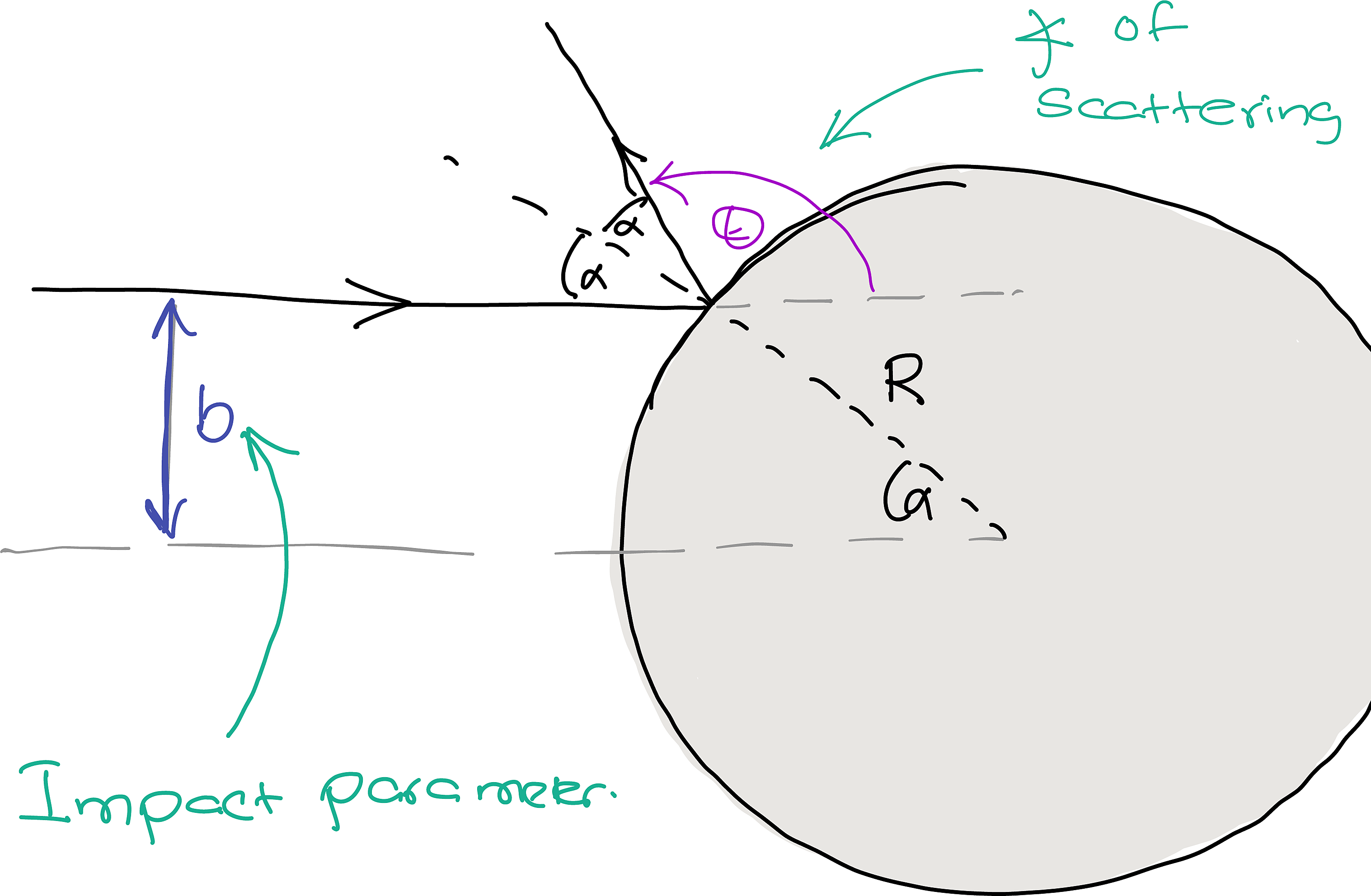
The image shows the scattering of a particle off a hard sphere of radius \(R\).
Write down an expression for the impact parameter, \(b\), in terms of the scattering angle, \(\theta\).
Use this expression to show that the angular differential scattering cross section, \(\dfrac{d\sigma}{d\Omega}\) is \(R^2/4\).
Hence, show that the total scattering cross-section is given by \[\sigma = \pi R^2\]
Does this value make physical sense? Please elaborate.
Problem 5.2(A Monte Carlo Electron Problem)
Estimate the probability of an electron with energy 100 keV scattering off an oxygen nucleus in a sample of PMMA(\(\text{C}_\text{5}\text{O}_\text{2}\text{H}_\text{8}\))?
The total screened Rutherford scattering cross-section for an electron with energy \(E\) (in keV) for a nucleus of atomic number \(Z\) is: \[ \sigma = 5.21\times10^{-21}\,\dfrac{Z^{2}}{E^{2}} \dfrac{4 \pi }{\alpha \left( 1+\alpha \right) } \left( \dfrac{E+511}{E+1024}\right) ^{2} \qquad \text{cm$^2$/atom} \] where \(\alpha\) is the ‘screening parameter’: \[ \alpha = 3.4\times10^{-3}\,\f{Z^{0.67}}{E} \]
and
| Element | H | C | O |
|---|---|---|---|
| \(Z\) | 1 | 6 | 8 |
Problem 5.3(Transforming a Differential Cross-Section)
Suppose that elastic scattering is isotropic in the CM frame, so that
\[ \frac{\mathrm{d}\sigma}{\mathrm{d}\Omega^*}=C, \]
where \(C\) is a constant.
The LAB and CM differential cross-sections are related by
\[ \frac{\mathrm{d}\sigma}{\mathrm{d}\Omega} = \frac{\mathrm{d}\sigma}{\mathrm{d}\Omega^*} \left|\frac{\mathrm{d}\Omega^*}{\mathrm{d}\Omega}\right|. \]
For azimuthally symmetric scattering,
\[ \mathrm{d}\Omega=2\pi\,\mathrm{d}(\cos\theta). \]
Using
\[ \cos\theta = \frac{\cos\theta^*+\zeta} {\sqrt{1+2\zeta\cos\theta^*+\zeta^2}}, \qquad \zeta=\frac{m_1}{m_2}, \]
derive the Jacobian
\[ \left| \frac{\mathrm{d}(\cos\theta^*)} {\mathrm{d}(\cos\theta)} \right|. \]
Hence, obtain an expression for the LAB differential cross-section.
Does an isotropic CM distribution necessarily appear isotropic in the LAB frame? Explain.
For equal projectile and target masses, use \(\theta=\theta^*/2\) to show that
\[ \frac{\mathrm{d}\sigma}{\mathrm{d}\Omega} = 4C\cos\theta, \qquad 0\leq\theta\leq\frac{\pi}{2}. \]
Explain how the total cross-section can remain unchanged even though the angular distribution looks different in the two frames.
Problem 5.4(The Klein-Nishina Cross Section)
Show that the Klein-Nishina Cross Section Equation 10.14 can be expressed as: \[ \da{\sigma}{\Omega} = \dfrac{1}{2} r^2_0 \lr{\dfrac{\lambda}{\lambda'}}^2\lrs{\dfrac{\lambda}{\lambda'}+\dfrac{\lambda'}{\lambda}-\sin^2 \theta} \]
Where \(\lambda'\) is the wavelength of the photon after scattering.
Show that the energy transferred to an electron during Compton scattering is given by: \[ T_e =\dfrac{E^2_\gamma (1-\cos\theta)}{m_ec^2 + E_\gamma(1-\cos\theta)} \]
where \(E_\gamma\) is the energy of the original photon.
Problem 5.5(Photon Absorption in Lead)
The total absorption coefficient for 5 MeV photons in lead is about \(0.04 \text{cm}^2/\text{gm}\).
If the density of lead is taken as \(11.3 \text{gm/cm}^3\):
- What is the half-thickness of lead for these \(\gamma\)-rays?
- What thickness of lead would be required to reduce the intensity of such photons to \(0.06\) of the initial value?